Explore the Namatjira Story

  • Home
  • A Broader Influence
  • Albert Namatjira
  • Arrernte Landscape Painting
  • Contemporaries
  • Descendants
  • Hermannsburg Potters

A Broader Influence

The life and work of Albert Namatjira have left a lasting legacy for artists throughout the country.

For many artists, Namatjira’s use of non-traditional colours and techniques was a liberating influence.

Aboriginal artists from across the country were active in the post-Namatjira period, many of them adopting his style as an Aboriginal painting style before the rise in popularity of the dot painting style in the late 1970s.

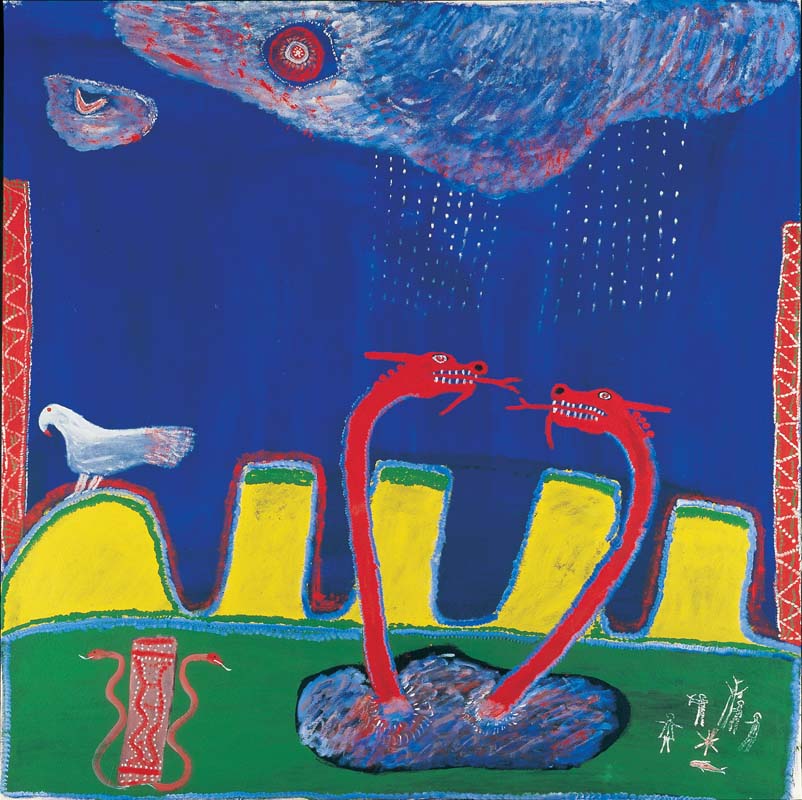
Ginger Riley Munduwalawala
Garimala (The Two Snakes) 1988

Not Currently on Display
  • Artwork
  • Artist

A prominent feature of the landscape near Ngukurr, where Ginger Riley Munduwalawala lived, is the Four Arches, a series of eroded volcanic rock formations. According to Mara legend, the Four Arches were created by two rival Dreaming creatures, the serpents Bandian and Bulukbun, the ancestors of Kurra Murra (king brown snake). Bandian represents order and stability, while Bulukbun represents disorder and chaos — a balance of these opposing forces is necessary for the continuation of life.

A third creature, Garimala, represents the ideal balance between competing natural forces. Also featured in this painting is Ngak Ngak, the totemic sea eagle. According to another legend, an island near the mouth of the Limmen Bight River was formed when Ngak Ngak flew over it. This was the ancestral country of Munduwalawala’s mother and is represented as the rounded formation upon which the sea eagle rests.

Ginger Riley Munduwalawala was an elder from Ngukurr, situated on the Roper River in south-eastern Arnhem Land in the Northern Territory. His ancestral land is some 45 kilometres from the mouth of Limmen Bight River in the Gulf of Carpentaria.

For Munduwalawala, the issues of ancestral land and heritage are inseparable from the creative process. His paintings emphasise the importance of his people’s ownership of the land. Originally he was inspired by the painting of Albert Namatjira, but he found the Western-influenced style difficult, and was unhappy with the results of his work.

In 1986, with the encouragement of the local school principal, he again experimented with painting, developing a distinctive, colourful and expressionistic style that brought him considerable fame. Munduwalawala employed bright, clear colours in acrylic to paint ancestral stories in a highly accessible style.

Ginger Riley Munduwalawala / Mara people, Narritj skin group / Australia 1937–2002 / Garimala (The Two Snakes) 1988 / Synthetic polymer paint on canvas / 178 x 177.4cm / Purchased 1990 with funds from ARCO Coal Australia Inc. through the Queensland Art Gallery Foundation / Collection: Queensland Art Gallery | Gallery of Modern Art / © The Estate of Ginger Riley Munduwalawala / Courtesy: Alcaston Gallery, Melbourne

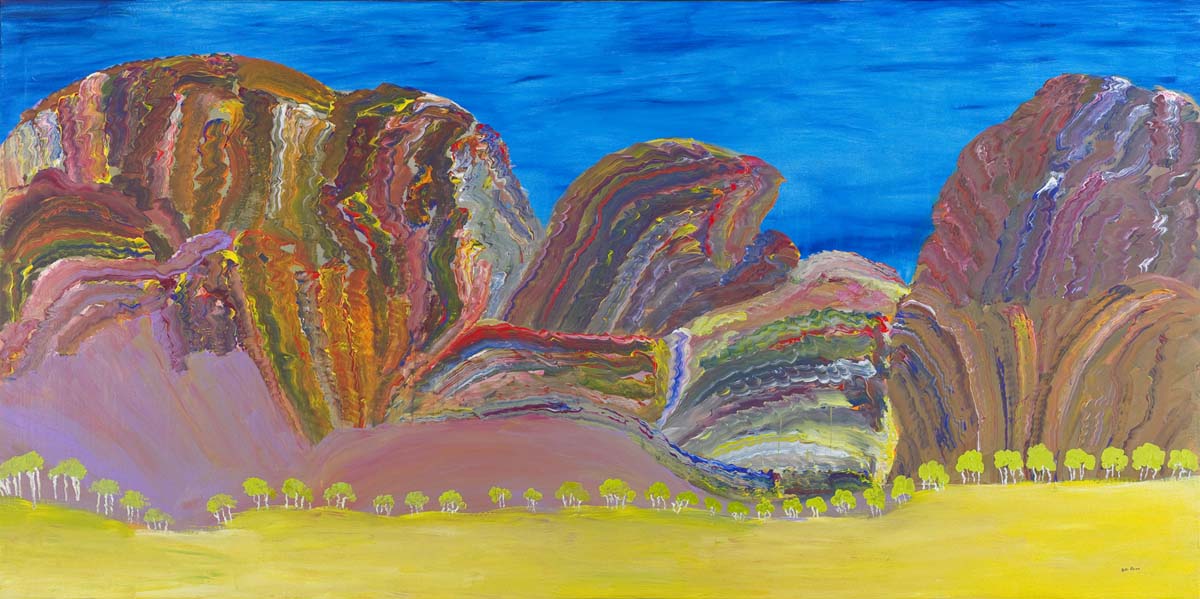
Kwementyaye Benn
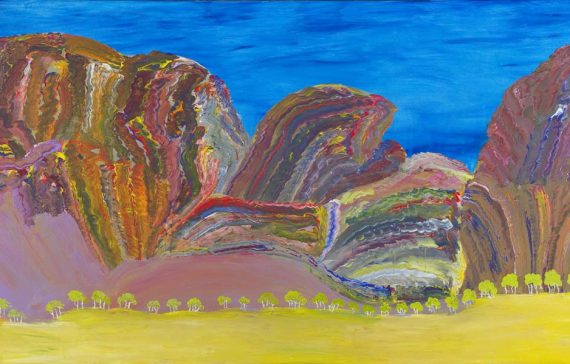
Artyetyerre – Harts Range 2008

Not Currently on Display
  • Artwork

As a boy in the 1950s, Ginger Riley Munduwalawala, a Mara painter from the Gulf of Carpentaria, met Albert Namatjira. For many artists, Namatjira’s use of non-traditional colours and techniques was a liberating influence and, when Riley took up painting later in life, his richly toned landscapes, which place his ancestors within their country, were lauded around the world.

Kwementyaye Benn / Alyawarre people / Australia c.1943-2012 / Artyetyerre – Harts Range 2008 / Synthetic polymer paint on canvas / 150 x 300cm / Purchased 2008. Queensland Art Gallery Foundation / Collection: Queensland Art Gallery / © The artist

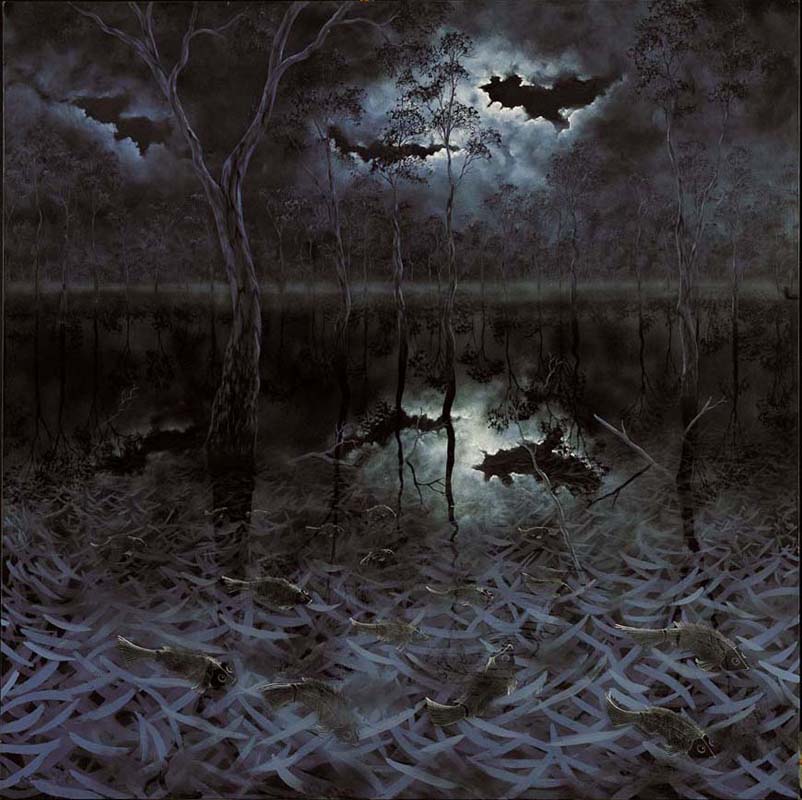
Lin Onus
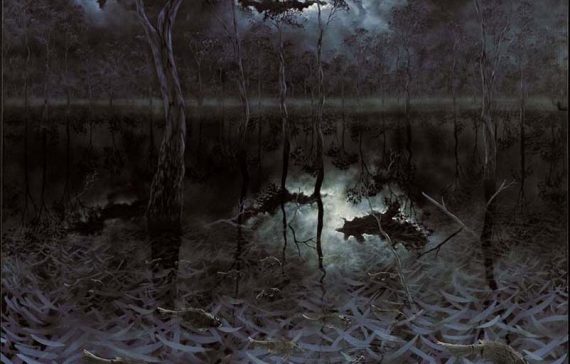
Morumbeeja Pitoa (Floods and moonlight) 1993

Not Currently on Display
  • Artwork
  • Artist

This painting shows the artist’s country, Barmah Forest, in flood by moonlight. Flooded gums and silver-lined moonlit clouds are reflected in the water. Below the surface, fish are decorated in rarrk, a traditional crosshatching design, which Onus learnt in Arnhem Land.

This incorporation of traditional Aboriginal painting styles into western realist landscapes – an Onus trademark – is an insistent reminder that this is Aboriginal land.

Lin Onus was born in Melbourne in 1948. His father Bill Onus was a Yorta Yorta man from the Aboriginal community of Cummeragunja in Victoria, near the town of Echuca, while his mother Mary McLintock Kelly was from a Scottish family in Glasgow.

As a child, Onus visited Cummeragunja with his father, and was told stories by his uncle Aaron Briggs, who gave Onus his Aboriginal name — Burrinja, meaning ‘star’. After leaving school at 13 he worked as a motor mechanic before joining his father’s business, Aboriginal Enterprises, making artefacts for the tourist market.

Appropriation, copyright and equality associated with the manufacture and trade of Aboriginal tourist items were critical issues that would later occupy Onus’s art and life. The discovery of a set of oil paints at his father’s workshop led Onus to painting small landscapes that he sold through the Sherbrooke Art Society Fair in 1974.

In 1975, Onus mounted his first exhibition at the Victorian Aborigines Advancement League in Melbourne. This organisation was symbolically significant for the young artist, foreshadowing the powerful link between his art and the political and cultural milieu that was to become a distinguishing characteristic of his career.

In 1986 Onus was introduced to the Gamerdi community at Maningrida in Arnhem Land and met traditional elders such as Jack Wunuwun (who became his adoptive father and mentor). Onus’s pilgrimages to the community allowed him to acquire knowledge about symbols, patterns, designs and stories, to develop a distinctive visual language.

In 1993 he was awarded the Order of Australia for service to the arts. Despite his premature death at the age of 47, Lin Onus has been widely acknowledged as a pioneer of the Aboriginal art movement in urban Australia.

Lin Onus / Australia 1948–96 / Morumbeeja Pitoa (Floods and moonlight) 1993 / Oil on canvas / 182.5 x 182.5cm / Purchased 1995. Queensland Art Gallery Foundation / Collection: Queensland Art Gallery | Gallery of Modern Art / © Lin Onus Estate 1994. Licensed by Viscopy, 2016