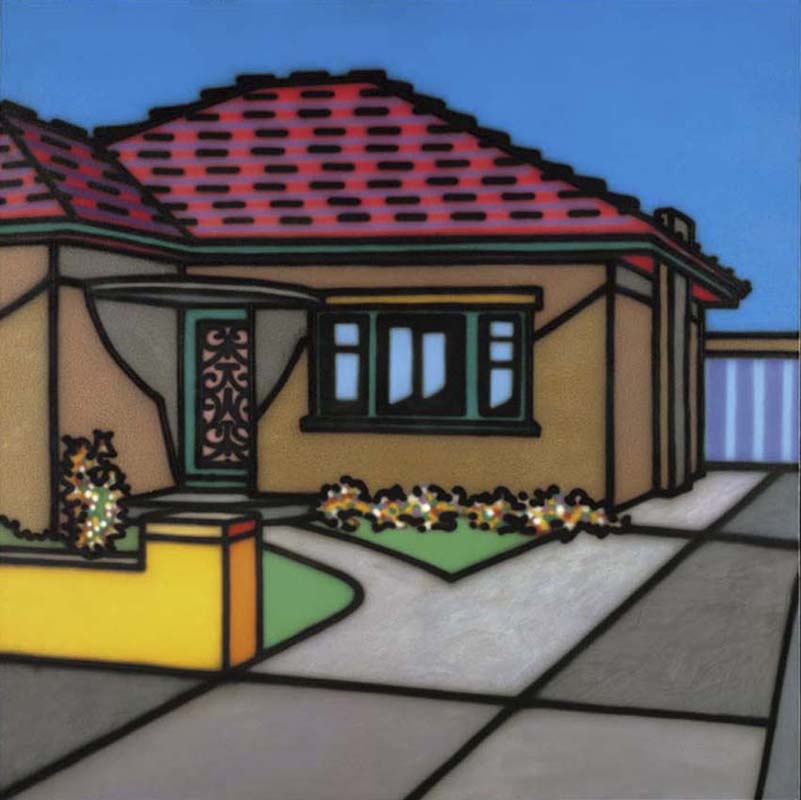
Howard Arkley / Australia 1951–99 / Stucco home 1991 / Synthetic polymer paint (with ‘Hammertone’) on canvas / 167 x 167cm / Purchased 1994. Queensland Art Gallery Foundation / Collection: Queensland Art Gallery / © Howard Arkley Estate
Howard ArkleyStucco home 1991
Not Currently on Display
Howard Arkley’s portraits of suburban Melbourne houses are among the most dedicated and serious of any artistic study of Australian suburban culture. His obsessive interest in suburbia is partly a reaction against the mythic status of the outback landscape among Australian artists, most of whom live in cities.
Despite the superficial or satirical appearance of the work, the meticulously decorative surface of Stucco home 1991 is a careful portrayal not only of the house, but also of the almost clinical precision displayed by the home’s owners.
As a reflection of comfort and propriety, Arkley intensifies the seemingly mundane domestic subject matter into a stylised façade, suggesting that there is more to be revealed behind the tidy exterior. Through the large blank picture-window, Arkley creates an ambiguous impression that there is a not-quite perceptible, vaguely sinister form behind the dark glass.
Like a psychologically revealing portrait of a person, this picture of a house combines a familiar public image with a more complex speculation on the anxieties or insecurities experienced by people living out their day-to-day existence in 90s suburban Australia.
Born in Melbourne in 1951, Howard Arkley received a Diploma in Art and Design from the Prahran College of Advanced Education in 1972 and a Diploma of Education in 1973. At Prahran he was introduced to air-brushing by Fred Cress, and other early influences for Arkley included the work of Sidney Nolan and surrealism. Arkley’s work was selected for the Australian Pavilion at the 1999 Venice Biennale.
In 1976 he spent 12 months travelling in Europe and the United States before returning to Australia. Arkley began to use suburban imagery in 1978 when he painted his ‘Doorway’ series, reproducing the patterns of flyscreen doors, which struck him for the great variety of their wrought iron designs. The fact that something so banal and ubiquitous could generate such an array of stylistic variation alerted him to the ways that the suburban house can be a means of self-expression.
What is emphasised above all else in Arkley’s work is the importance of the cultural fragment in his approach to art. Arkley’s adherence to the airbrush has the effect of depersonalising the marks he makes on the canvas. Behind his highly refined compositions are enormous volumes of images and ideas taken from magazines, books, toys, television, scientific literature, horror films, art history and the media. He distils archives of society through an iterative process, the initial ideas, objects and images undergo a transition to inform the final work.
Individual doodles become the inspiration for entire paintings. Arkley refers to his doodles as ‘casual art’; he has a book for all occasions: a ‘tram book’, a ‘pub book’ and so on. Arkley produces his doodles by a process similar to the surrealist’s attempts at ‘automatic writing’. Afterwards he goes through the books, selecting particularly powerful images and transferring them onto canvas. The resulting paintings are perplexing jumbles of shapes that can be freely interpreted.1
Endnotes:
1. Edited extract from: ‘Casual works: working drawings, source material, doodles 1974-87’. Gertrude Street Artist’s Space, Melbourne, 1988.