We acknowledge the Traditional Owners of the land on which the Queensland Art Gallery | Gallery of Modern Art stands and recognise the creative contribution First Australians make to the art and culture of this country.
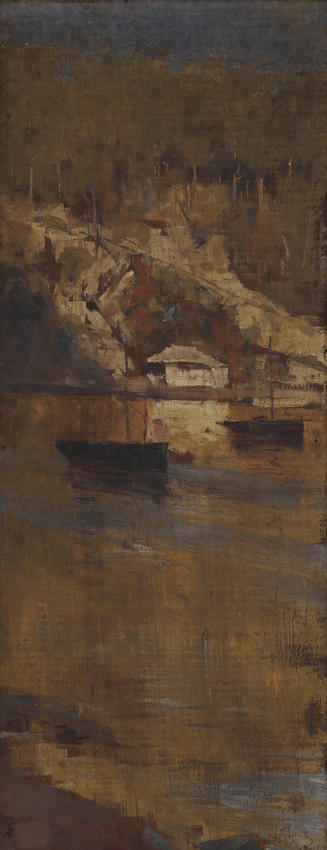
Arthur Streeton / Australia 1867–1943 / Sunny cove 1893 / Oil on wood panel / 53.4 x 21cm / Purchased 1961 / Collection: Queensland Art Gallery | Gallery of Modern Art
Arthur StreetonSunny cove 1893
Not Currently on Display
Tom Roberts founded the Curlew Camp on Little Sirius Cove in Sydney in 1891. Here he was joined by Arthur Streeton, and from 1896 they shared a city teaching studio. This work was done during this time and captures the impressionist play of light on the waters of the cove.
Arthur Streeton was born in 1867 near Geelong, Victoria. His family moved to Melbourne, and from 1882 to 1888 Streeton attended evening classes at the National Gallery of Victoria School of Design, where he participated in plein-air painting excursions to Heidelberg.
Streeton joined artists’ camps at Box Hill and Eaglemont in the late 1880s, together with Tom Roberts, Frederick McCubbin and Charles Conder. In about 1897, he sailed for Europe, spending time in Cairo and Italy before settling in London in 1899. He returned to Melbourne in the 1920s where he lived until his death in 1943.
Arthur Streeton made a significant contribution to the way Australia imagines itself. The romance and beauty of his landscapes reflect the vision of Australian art at the turn of the twentieth century and highlight the importance of rural life and landscapes in this nation’s experience.
Streeton was seen as the hero of an ambitious beginning for Australian art, one that assumed it could discard conventional European art styles.
I want to be painting every day . . . I picture in my head the Murray and all the wonder and glory at its source up toward Koscuisko [sic] . . . and the great gold plains, and all the beautiful inland Australia and I love the thought of walking into all this and trying to expand and express it in my way.[1]
While this ambition established new pictorial forms, its impetus for a national art never wholly discarded imported methods of responding to the landscape, especially aspects of European Romanticism.
Discussion Questions
What is the focal point of this composition? How has Streeton used line and contrast to emphasise this feature in this painting?
Classroom Activities
Gather images of the outdoors from magazines. Identify the focal point in each of the images. Analyse how the image establishes a focal point by breaking down (roto-scoping, tracing, folding, cutting, rearranging) photocopies or scanned prints of the images.