We acknowledge the Traditional Owners of the land on which the Queensland Art Gallery | Gallery of Modern Art stands and recognise the creative contribution First Australians make to the art and culture of this country.
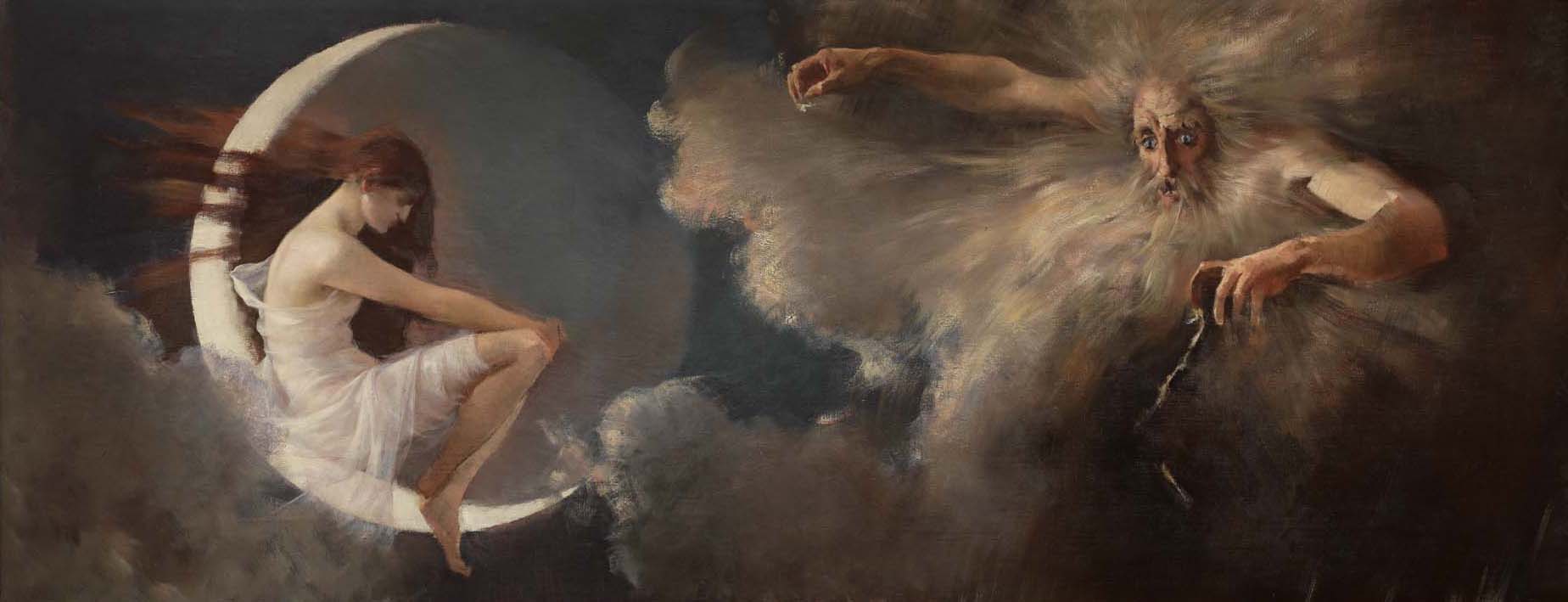
Arthur Loureiro / Australia 1853–1932 / Study for ‘The spirit of the new moon’ 1888 / Oil on canvas / 56 x 165cm / Purchased 1995. Queensland Art Gallery Foundation Grant with the assistance of Philip Bacon through the Queensland Art Gallery Foundation. Celebrating the Queensland Art Gallery’s Centenary 1895–1995 / Collection: Queensland Art Gallery | Gallery of Modern Art
Arthur LoureiroStudy for ‘The spirit of the new moon’ 1888
On Display: QAG, Gallery 11
Study for ‘The spirit of the new moon’ is a rare and early example of the style known generally as Symbolism which was popular in France in the 1880s. With its emphasis on sensuality, spirituality and emotions, Symbolism as a movement thrived in opposition to the prevailing academic and realist modes of representation.
This evocative painting was inspired by a Portuguese poem, ‘Os Lusiadas’ (The Lusiads) by Luis vaz de Camoes published in 1572. In this epic poem, the goddess Venus comes to the aid of Portuguese sailors in battles with mortal enemies and with forces of nature powered by malevolent gods.
Loureiro depicts Venus confounding Adamastor, spirit of the Cape of Good Hope (south-west South Africa) who eventually granted the great navigator Vasco da Gama’s journey through the notoriously treacherous ocean passage known to all those attempting the onward voyage to India.1
Curiously, Loureiro’s fierce Adamastor appears to be fashioned in the image of Vasco da Gama himself. Clearly inspired by the explorer’s legacy, Loureiro named his only son Vasco when he was born in 1882.
Born into a conventional middle-class Portuguese family, Arthur Loureiro studied in Lisbon, Madrid, Florence, Rome and Paris.
He moved to Melbourne in 1884 and was one of eight artists who broke away from the Victorian Academy of Art to form the Australian Art Association in 1885, only to amalgamate with the Academy in 1888 to form the Victorian Artists’ Society.
Endnotes:
1. Clark, Jane. ‘International classicists in the “Australian Impressionist” era’, in Brought to Light: Australian Art 1850-1965. Seear, Lynne & Ewington, Julie (eds), Queensland Art Gallery, Brisbane, 1998, p.302.
Discussion Questions
This work shows Loureiro’s imaginative vision of the new moon inspired by a Portuguese poem, ‘Os Lusiadas’ (The Lusiads) by Luis vaz de Camoes published in 1572. Discuss the relationship between the visions of artists and poets within the world of dreams.
Classroom Activities
1. Research the cycles of the moon and its impact on earth. Which moon phases has Loureiro depicted?
2. Find a poem about celestial beings or astronomy to illustrate allegorically (figuratively) some of the research you have uncovered. Use imaginative scenes and symbolism similar to Loueiro and other painters from the Australian Symbolist movement.