We acknowledge the Traditional Owners of the land on which the Queensland Art Gallery | Gallery of Modern Art stands and recognise the creative contribution First Australians make to the art and culture of this country.
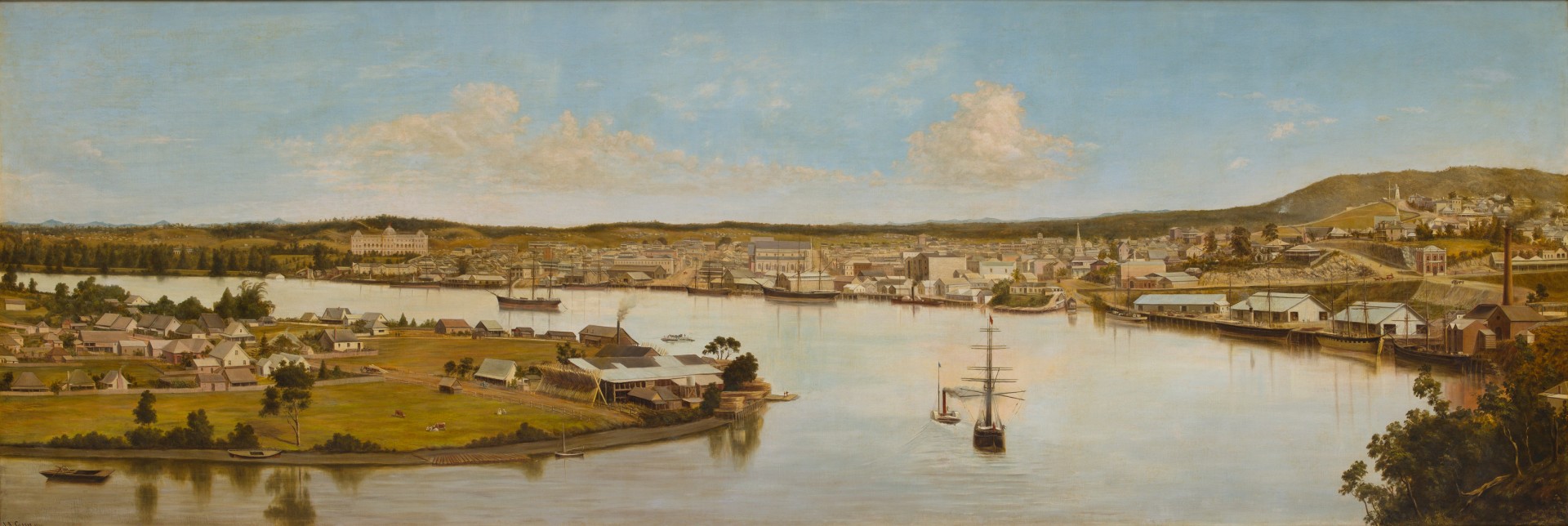
J.A. Clarke / England/Australia 1840–90 / Panorama of Brisbane 1880 / Oil on canvas / 137.1 x 365.7cm / Collection: Queensland Museum
J.A. ClarkePanorama of Brisbane 1880
On Display: QAG, Gallery 10
This ambitious panorama, on loan from the Queensland Museum, is Queensland’s most significant nineteenth-century painting. It was commissioned by the Queensland Government for the colony’s exhibit at the Melbourne International Exhibition of 1880.
The purpose of J.A. Clarke’s ‘grand picture’ was, in the rhetoric of the time, ‘to record the progress of civilisation in the colonial capital since European settlement 56 years earlier’. This ‘progress’ is evident in the wharves, warehouses, factories, shops, churches, residences, parks, transport and, above all, in a series of fine public buildings.
In the left foreground, situated on the riverbank at Kangaroo Point, is Birley’s Sawmills. The prominent sandstone building opposite Kangaroo Point is Parliament House. The suburb of Spring Hill is in the centre of the painting, and the range of hills towards the far right runs up to One Tree Hill, now known as Mount Coot-tha. Today, this view can be seen from the Wilson Outlook Reserve on Bowen Terrace, New Farm. The Story Bridge, one of Brisbane’s iconic structures, now stands at the bend in the river where the large ship is sailing toward the viewer.
Joseph Augustus Clarke was Queensland’s first professional artist and art teacher, and is best remembered in Brisbane as a pioneer teacher. Born in Kent, England, in 1840, he studied at the Royal College of Art in South Kensington, arriving in Australia around 1870. During the 1870s, Clarke illustrated covers of the Queenslander newspaper and the literary edition of The Brisbane Courier, now known as The Courier-Mail.
In 1880, Panorama of Brisbane became the key work of Brisbane’s first major artist. It was shown at the Queensland Royal National Association exhibitions in 1879, 1885 and 1887. Also well known is Clarke’s portrait of Dr James Quinn, Roman Catholic Bishop of Brisbane, which he painted for All Hallows’ Convent.
Clarke became the first teacher of drawing at the Brisbane School of Arts in 1881 and remained there as Art Master until his death in 1890.
Discussion Questions
1. Do you know from where Clarke painted this view of the Brisbane River? A lot has changed in Brisbane since this scene was painted in 1880, but can you identify any natural and constructed elements that remain?
2. Brisbane is a river city. Think of all the ways the river plays a role here and consider what role the Brisbane River plays today.
Classroom Activities
If you were to design ‘Riverfire’ or the Brisbane Festival, what types of events or activities would you develop to celebrate the Brisbane River? In teams, create a program of activities that will encourage families to learn more about the value of the river to Brisbane life.