We acknowledge the Traditional Owners of the land on which the Queensland Art Gallery | Gallery of Modern Art stands and recognise the creative contribution First Australians make to the art and culture of this country.
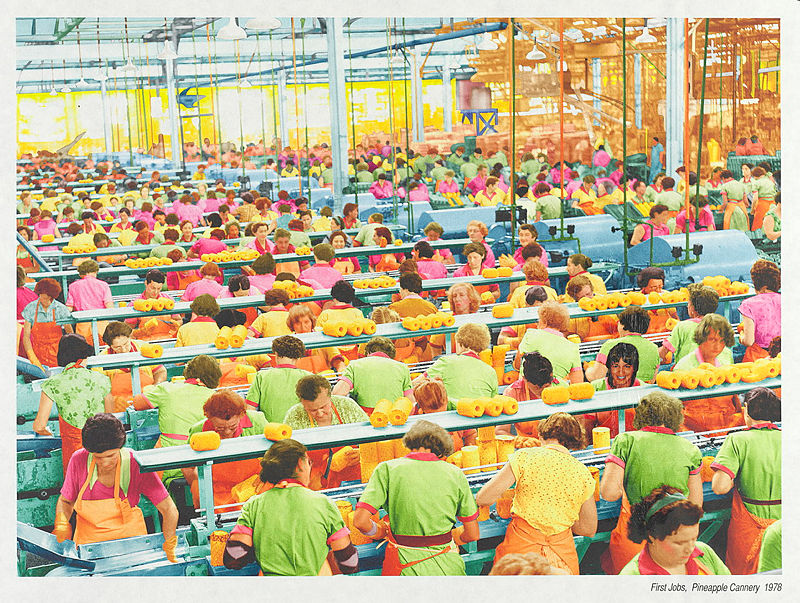
Tracey Moffatt / Queensland Australia b.1960 / First jobs, pineapple cannery 1978 (from ‘First jobs’ series) 2008 / Archival pigments on rice paper with gel medium / 66.5 x 88cm / Gift of Patrick Corrigan AM through the Queensland Art Gallery Foundation 2010. Donated through the Australian Government’s Cultural Gifts Program / © Tracey Moffatt
Tracey MoffattFirst jobs, canteen 1984 2008
On Display: Regional Touring Exhibition
Tracey Moffatt’s ‘First jobs’ series is both a real and imagined visual catalogue of her early work experience. The artist has selected images from period sources, overlayed them with high-key colour, and substituted a face in each historical photograph with her own cheerfully smiling one.
Tracey Moffatt was born in 1960 and grew up in Brisbane. After graduating from the Queensland College of Art, where she studied film and video production, she moved to Sydney in 1983 and worked as an independent filmmaker and photographer. As artist in residence at the Albury Regional Art Centre in 1989, she produced her critically acclaimed ‘Something more’ series.
Moffatt gained critical acclaim for her short film Night cries: A rural tragedy, which competed in the Cannes Film Festival in 1990. Moffatt’s work has been shown in solo exhibitions, including QAGOMA’s ‘Tracey Moffatt: Spirited’ in 2014, which showcased the ‘Night spirits’ series, and major group exhibitions such as the São Paulo Biennial and the Venice Biennale in 1997, and the Sydney Biennale in 1992, 1996 and 2000.
Moffatt refuses to be categorised as an ‘Aboriginal’ artist, finding the term stereotypical and politicised. However, several of her works have been concerned with issues especially affecting Indigenous Australians such as poverty, displacement and racism. She represented Australia at the 57th Venice Biennale in 2017.
Endnotes:
1Ewington, Julie. ‘Tracey Moffatt: Plantation’, in ‘The 6th Asia Pacific Triennial of Contemporary Art’. Queensland Art Gallery, Brisbane, 2009, p.140, col. ills p.26 (stills).