We acknowledge the Traditional Owners of the land on which the Queensland Art Gallery | Gallery of Modern Art stands and recognise the creative contribution First Australians make to the art and culture of this country.
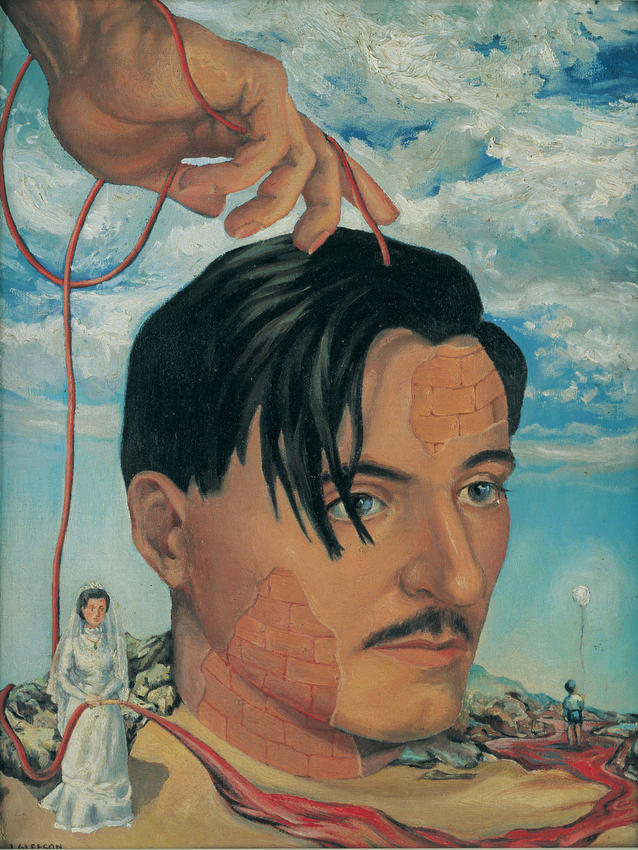
James Gleeson / Australia 1915–2008 / Structural emblems of a friend (self portrait) 1941 / Oil on canvas board / 46 x 35.6cm / Purchased 1984 with the assistance of the John Darnell Bequest / Collection: Queensland Art Gallery | Gallery of Modern Art / © QAGOMA
James GleesonStructural emblems of a friend (self portrait) 1941
On Display: QAG, Gallery 4
James Gleeson wrote of this painting, ‘I’m always fascinated by the ambiguity of matter – things that look like one thing and could be something else. The flesh and stone or brick seemed to me to be opposites that somehow combined. This gives a strange intensity to the image. There is the idea of a vein of blood, a hose of blood, life-force, flood of blood, I don’t know what it is – something to do with continuity. The hand of God – with the hose coming into the head.’
James Gleeson is regarded as Australia’s leading surrealist painter. TS Eliot’s poetry and the paintings of Salvador Dali (first shown in Australia in 1939) inspired much of his early work. Gleeson’s meticulous painting style dramatises the space between realistic depictions of people and objects (reality) with a heightened sense of experience (surreality). Painting from imagination, he has expressed inner drives and necessities that cannot be seen, but are manifested in human form, since Gleeson believes that art must include the human element.
Gleeson is noted for his superb command of traditional artistic techniques. Apart from painting, he has produced drawings, watercolours, pastels and collages. Gleeson aims to go beyond surface realities to explore inner ones. His collages combine both organic and mechanical forms and suggest both past and future worlds. He has stated, ‘Our senses are narrow and deficient. I try to see beyond what we can see, beyond the limitations of our senses and to paint the things that we can’t see’.
Discussion Questions
Surrealist artists often place realistic elements in relationship to each other in ways that blur reality. List three pairings of elements that are placed near each other in this painting that could never actually occur in reality. Placing the elements together changes their meaning. Choose one of these pairs and discuss what the combination of these elements could mean.
Activities
Gather imagery from a variety of sources and combine your pictures into a composite image. Research the surrealist game known as The Exquisite Corpse to find inspiration.