We acknowledge the Traditional Owners of the land on which the Queensland Art Gallery | Gallery of Modern Art stands and recognise the creative contribution First Australians make to the art and culture of this country.
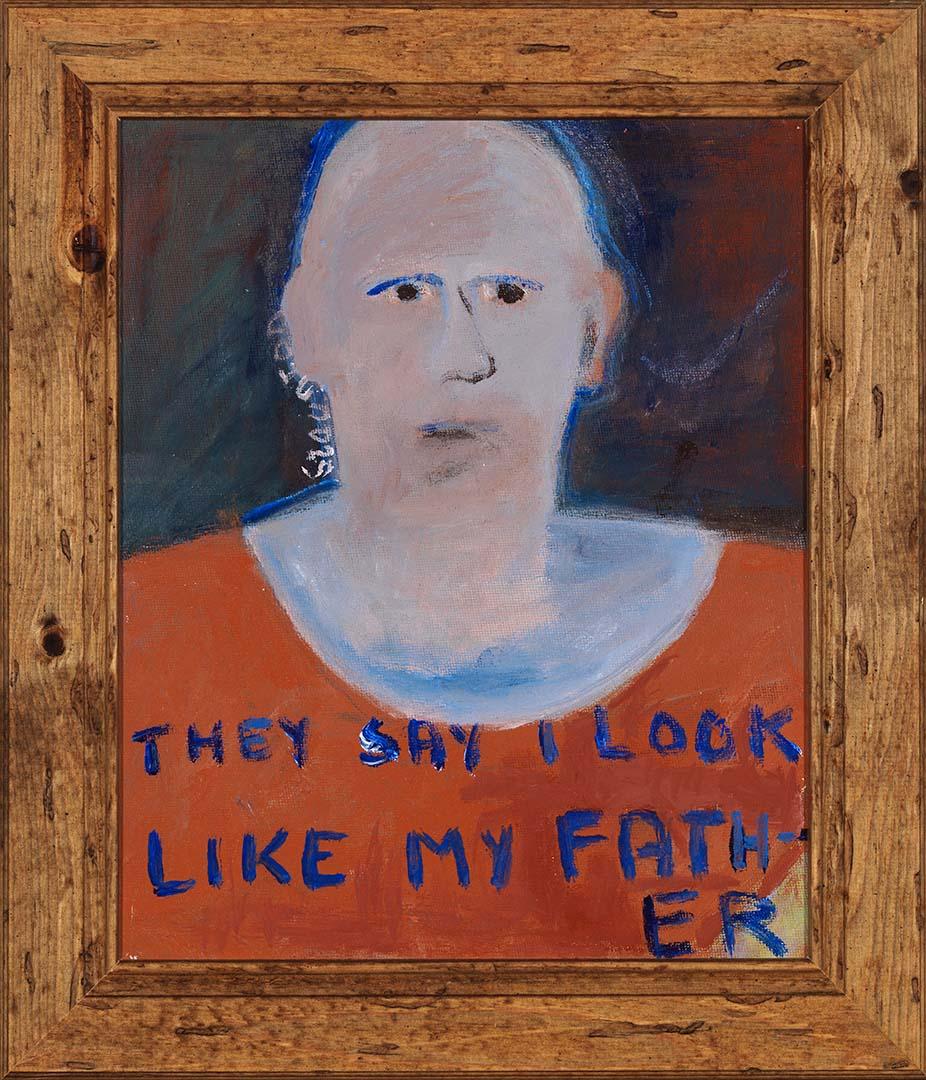
Madonna Staunton / Australia QLD 1938 – 2019 / They say 2010 / Synthetic polymer paint on canvas / 38 x 32.8 x 2.2cm (framed) / Purchased 2014 with funds from the Estate of Jessica Ellis through the Queensland Art Gallery | Gallery of Modern Art Foundation / © Madonna Staunton
Madonna StauntonThey Say 2010
On Display: Regional Touring Exhibition
Personalised, yet commonly relatable, Staunton’s practice expresses learnings from an inventory of life events and broad observations. They say 2010 is an example of Staunton’s capacity to delve deep into the psyche to offer insights into mortality, morality and the experience of the interior worlds that resonate across the human experience.
The painting is an investigation into the artist’s sense of self through portraiture. Though she carefully strived to avoid being didactic, They say as well as No one said 2010 can both be read as late career self-portraits fused with brooding feelings surrounding family inheritance. Painted in murky tones the work is a composite of Madonna Staunton’s identity against the suggestion of her father’s likeness. The work’s title, the interplay between the contrasting palette of blue, neutral tones and red-orange, as well as the expressively painted self-referential text framing the portrait, infer a desire to be recognised in her own right.
Born and raised in Murwillumbah, in northern New South Wales, Madonna Staunton made Brisbane her home, first exhibiting her paintings with the Royal Queensland Art Society (1956–61), and then the Brisbane Contemporary Art Society (1966–71). From the mid 1970s, Staunton abandoned painting to concentrate on collage and assemblage. These works have a complex lineage that can be traced through Dada, Constructivism, Fluxus and Abstract Expressionism.
Staunton gave new life to found paper, images and things, combining just a few items in works of restrained and cool harmony. As former Gallery curator, Tim Morrell, stated:
A play between randomness and precision animates virtually all Madonna Staunton’s assemblage work. Her sensitivity to tonal and formal arrangement always remains acute during this process and the results are austerely beautiful.1
Staunton returned to painting later in life, committing her eloquence to figurative painting, and these late representational works reveal insights that come with maturity and deep reflection.
Endnotes:
1 Timothy Morrell, ‘Madonna Staunton: Institute of Modern Art, Brisbane, 13 March – 18 April 2003 [review]’, Artlink, June 2003, <artlink.com.au/articles/2421/madonna-staunton>, viewed August 2020.