We acknowledge the Traditional Owners of the land on which the Queensland Art Gallery | Gallery of Modern Art stands and recognise the creative contribution First Australians make to the art and culture of this country.
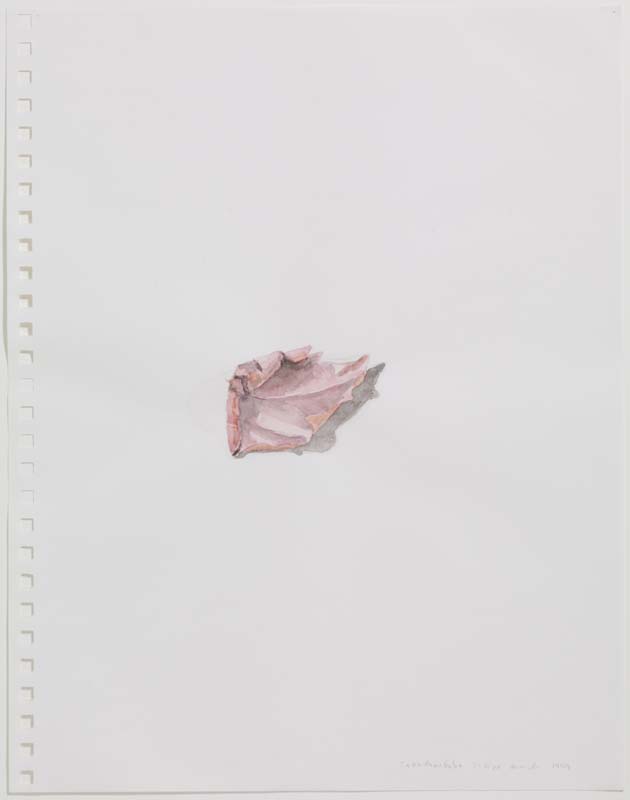
Eugene Carchesio / Australia b.1960 / Dead leaves of Tokyo (detail) 1999 / Sketchbook containing 39 compositions, occupying 43 leaves; watercolour on paper / Purchased 1999. Ivy Lillian Walton Bequest / Collection: Queensland Art Gallery | Gallery of Modern Art / © Eugene Carchesio
Eugene CarchesioDead leaves of Tokyo 1999
Not Currently on Display
The 39 watercolours that constitute Dead leaves of Tokyo are the product of three months Eugene Carchesio spent in Japan in 1999 on an Australia Council residency. In these works, Carchesio explores more fully the potential of the decaying leaves to represent a state of mind or a way of seeing. The stark rendering of the leaves, so small in scale against the austerity of the white drawing paper, reinforces the poignancy of this ephemeral subject matter. The shadows which haunt each leaf are delicately rendered in pale grey which shimmers humbly against the earth brown.
Scientific illustration is not the objective of the artist; rather, these drawings offer meditations on the everyday and signal the places he visited during his stay in Japan. This daily practice of seeking out leaves to work on in his studio brings together time, art, life and philosophy.
The very nature of Eugene Carchesio’s work makes it very difficult to describe it in words. His art is about the enigmatic, the mysterious, the spiritual. While he creates objects which are pleasurable simply in their visual effects, they are also very complex intellectually and conceptually.
Carchesio always works on a minimal and miniature scale, in direct opposition to the monumental oil on canvas productions of many contemporary artists. His choice of materials is very important and he often works on scraps of paper or card as a deliberate move away from so-called ‘artist’s materials’. He opposes any notion of current movements and styles and, rather, works from within his own experiences and thoughts. Carchesio is a musician and a wide reader, his artworks reflecting these interests. However, Carchesio’s work has many sources including science, geometry, Oriental mysticism and art history (particularly Russian Constructivism and the work of Joseph Beuys).
Eugene Carchesio has said of his art:
‘I deal in trying to move people’s insides. I guess the greatest thing a work of art can do is to inspire. A life process . . . always moving . . . creating . . . breathing with your head. Indicating what is perhaps beyond things . . . Everything is spiritual. But also when I make a work I develop a strong sensual bond to it. I won’t be able to take my eyes off it . . . I just keep looking and looking into it, going deeper into the colours, texture or whatever medium it is . . . sink into this created world.’