We acknowledge the Traditional Owners of the land on which the Queensland Art Gallery | Gallery of Modern Art stands and recognise the creative contribution First Australians make to the art and culture of this country.
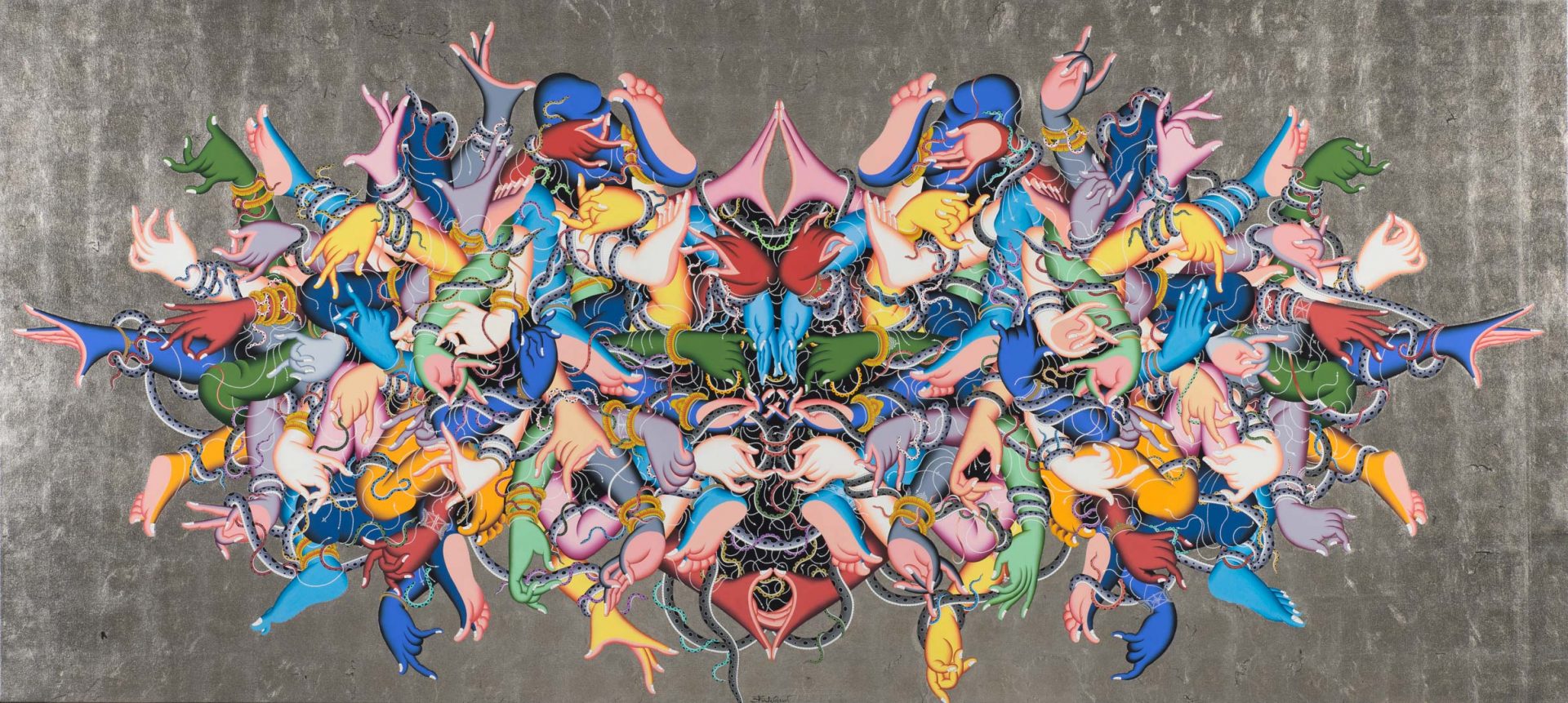
Tsherin Sherpa / Nepal b.1968 / Muted expression 2015 / Synthetic polymer paint, ink and platinum leaf on canvas / 116.5 x 259.5cm / Purchased 2015. Queensland Art Gallery | Gallery of Modern Art Foundation / Collection: Queensland Art Gallery | Gallery of Modern Art / © Tsherin Sherpa
Tsherin SherpaMuted Expression 2015
Not Currently on Display
Tsherin Sherpa’s images of deities and spiritual figures are often fragmented, placed in unusual contexts, or broken up into energetic deconstructions, which he describes as a metaphor for the feelings of displacement experienced by the Tibetan diaspora. He still feels a spiritual depth and ongoing connection to the development of thangka painting with renewed motivation to broadening its audience, and attests that he can never disregard his traditional training and faith while creating new works.
The painting, Muted expression, is a large-scale painting of a mass of colourful hands and feet wrapped in snakes. With their fingers either poised in gestures of prayer or meditation, or open in a movement of release, they rest against a rich platinum leaf background. In Muted expression Sherpa employs a strategy that reappears throughout his practice, of enlarging single details from a thangka painting so that the images become almost abstract and divorced from their origin.
Thangka painting relies on a formal grid system to place the deity’s body in the correct posture, and Sherpa’s fragmentation of the body of the deity and his removal of the supporting grid suggests a sense of uncertainty and groundlessness. Through experimentation with this disciplined art form, Sherpa provides an alternative take on the meditative energy, while similarly experimenting with format. The painting executes the motif on a dramatic scale, while the overall symmetry and balance echo the geometry of a mandala, continuing to lend a sacred quality to the composition.
Born in Nepal, Tsherin Sherpa belongs to several generations of exiled Tibetans, many of whom have never stepped foot on the soil of their ancestral homeland. From the age of 12 Sherpa was trained in the art of Tibetan thangka painting by his father, Master Urgen Dorje, who learnt from his uncle in Tibet in the 1950s. Sherpa is now regarded as one of the foremost contemporary Tibetan artists, along with artists such as Gongkar Gyatso, Gade, Nortse and Tenzing Rigdol.
Living in Kathmandu, Sherpa found he had little access to other Tibetan Buddhist art and artists, unlike the rich artistic Buddhist networks of Tibet in which his father matured. He became disillusioned with the role of being a thangka artist. Sherpa was conscious of the tourist demand for such work in Nepal, and was even embarrassed to tell his friends, when he was a teenager, that he practiced this art form.1 After moving to Taiwan to study for three years, he returned to Nepal to work with his father on traditional painting, before moving to California in 1998.
After settling in his new home, Sherpa gradually moved away from the precise discipline of thangka paintings to deconstruct and explore the abstract possibilities of the associated imagery, while maintaining the refined techniques and rich textures. His works incorporate ink and acrylic with gold and platinum leaf on cotton and canvas, ranging from small to large-scale scrolls and paintings of over three metres. The works provide a different perspective of the deities, spiritual beings and mandalas that have appeared on thangkas for centuries, reconstructing stylised hands and feet in contorted arrangements, or breaking figures up into swirling compositions.
Endnotes:
1. Tsherin Sherpa, ‘Bodhi in the mirror’, in Rachel Perera Weingeist et al., ‘Anonymous: Contemporary Tibetan Art’ [exhibition catalogue], Art Asia Pacific, Hong Kong, p.136.