We acknowledge the Traditional Owners of the land on which the Queensland Art Gallery | Gallery of Modern Art stands and recognise the creative contribution First Australians make to the art and culture of this country.
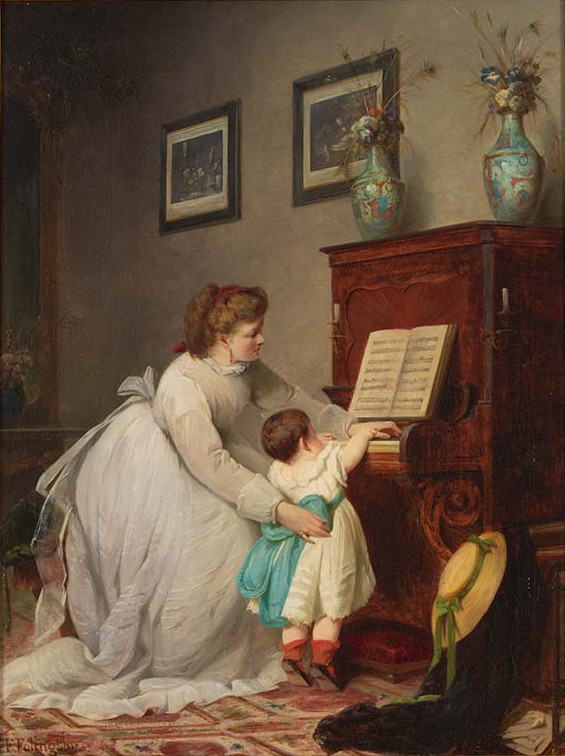
G.F. Folingsby / Germany/Australia 1828—91 / The first lesson 1869 / Oil on canvas / 83.5 x 63.8cm / Purchased 1990 / Collection: Queensland Art Gallery | Gallery of Modern Art
G.F. FolingsbyThe first lesson 1869
On Display: QAG, Gallery 10
The first lesson is both a narrative painting and a portrait. The painting shows the artist’s wife, Clara, and his daughter. Clara Folingsby was herself an accomplished artist known for her landscape paintings.
Considered to be one of Folingsby’s major works, The first lesson was exhibited at the Royal Academy in London in 1869. The painting is demonstrative of Folingsby’s skill in figure painting, drapery and costume. Featuring the elements of a patterned rug, cloisonné vases, prints on the wall, and a hat and cloak casually positioned to one side, the interplay of forms and shapes surrounding the figures are painterly devices that counterpoint colour notes and frame the narrative.
The composition’s conventional pyramid structure uses the gaze of Clara, as mother and teacher, to draw the viewer into the narrative. Her half-seated position allows the artist to explore the texture, trimming and fullness of her gown. The pale grey of her sash is played off in the darker grey of the prints, while the grey-green of her hat ribbon tonally and positionally elevates the bright blue-grey of the child’s sash. The use of red is developed in a similar way and extended to major furnishings, the patterned rug, and the warm mahogany tones of the piano’s timber form.
George Frederick Folingsby arrived in Melbourne, Australia, in July 1879 as an established history and portrait painter. He travelled extensively, studying and working across Europe as well as in New York, where at the age of 18 he was enrolled at the National Academy of Design and worked as an illustrator for Harper’s Magazine. He migrated to Australia with his daughter, having lost his wife Clara who passed away in 1874.
In June 1882, Folingsby was appointed as the ‘Master in the School of Painting’ at the National Gallery in Melbourne. By September he rose to the role of director. His teaching was a major influence on Australian painting and it formed the basis for several important figure paintings with Nationalist overtones. He also encouraged the combination of figures and landscape.
Several of Folingsby’s works show interior incidents of confrontation or dramatic discovery with the action arranged laterally or diagonally across the space. It is a conventional compositional device adopted by many of his students. Several significant Australian Artists were once pupils of Folingsby including Frederick McCubbin, David Davies, John Longstaff, Rupert Bunny and Emanuel Phillips Fox.
Discussion Questions
1. Take a minute to slowly look at this painting. What did you notice first? Has the artist used a particular method or technique to draw your eye to this section of the painting? Explain your thoughts.
2. Can you identify any items in the picture that may provide a clue that this painting was made a long time ago?
Activities
The artist has painted some objects with decorative patterns and shapes to include in his artwork (clue: look at the floor rug). Be inspired by a couple of different shapes or motifs you can find in the painting to create your own unique design.
Repeat the shape or motif on A4 paper to create a pattern. Using pencils or crayons, add colour to your decorative design.